

Episode: 366 • Duration: 01:14:19
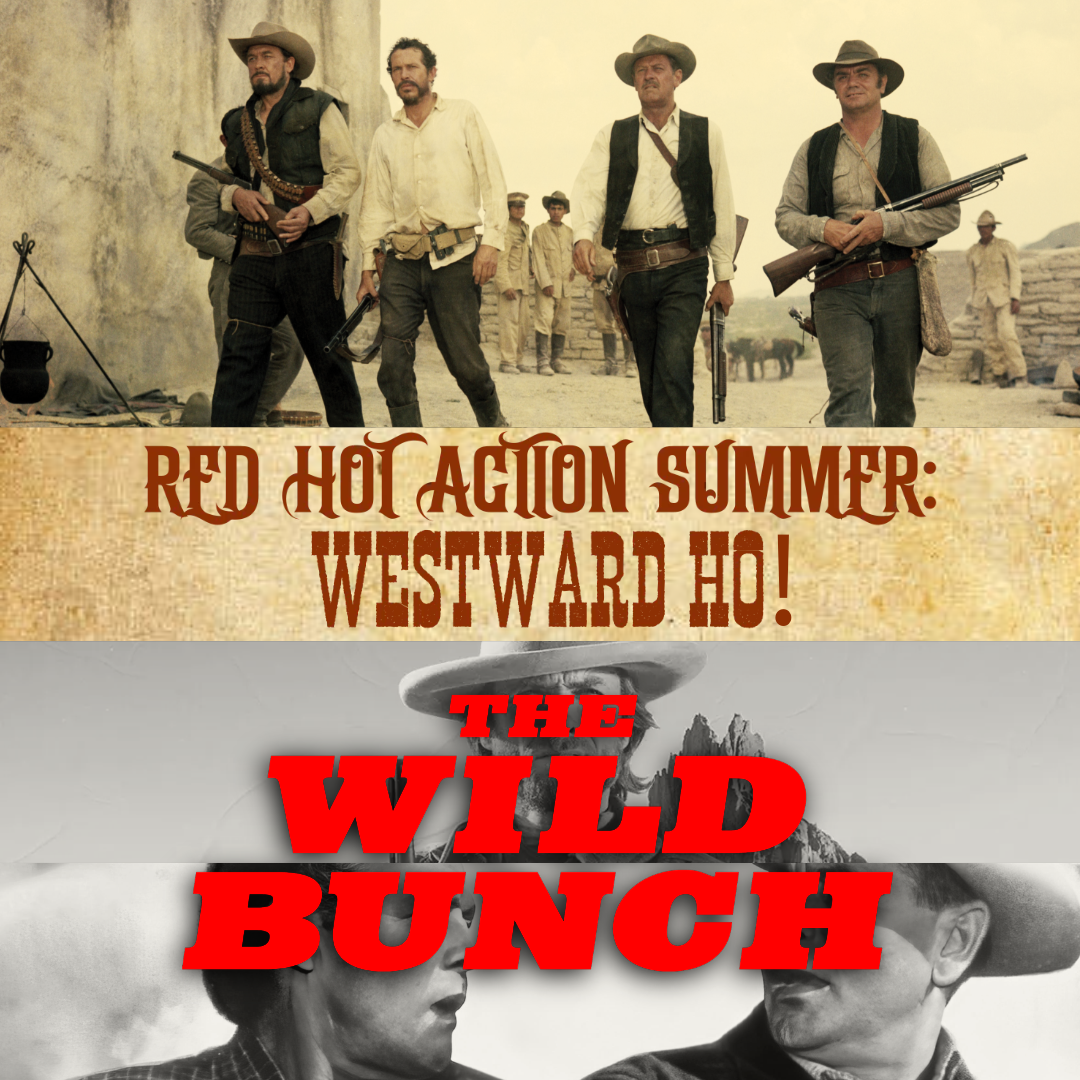
Howdy folks! We’re hitting the old dusty trail with Red Hot Action Summer: Westward Ho!, and we start it off with a banger from Sam Peckinpah (literally – there are a lot of squibs). We talk about this American western that follows a group of outlaws recognizing that their way of life needs to change, thanks to the exploits of the Mexican Revolution. We discuss the violence, the familiar themes, and even somehow get the Vietnam War in there.
Listen in all August as we tackle American westerns in our Red Hot Action Summer!
Hit that play button above to listen in.
Transcript – Red Hot Action Summer: Westward Ho! (1) THE WILD BUNCH (auto-generated)
Click to expand full transcript
0:01
Howdy partners.
Welcome back to the Blood of Black Rum podcast Red Hot Action Summer.
This year, we’re not going to a specific era.
Instead, we’re heading out West, what we’re calling Westward Ho.
This time you’ll find American Westerns from all kinds of eras.
0:19
There’s sure to be some Clint Eastwood, some Pecked Pot and Ethan John Wayne with a couple of surprises thrown in as well to tell your mom pop, come on out, saddle up and listen in all August for red hot action summer Westward Ho.
0:40
Hey everyone, it’s Ryan from blood and Micron podcast.
I’m joined with my Co host Martin.
How’s it going?
Or how do y’all?
Yeah.
Howdy partner.
Well, we are into our Red Hot Action summer do this every year, starting it just a little bit early.
1:00
I think we normally start right at the beginning of August, and this episode is going to hit just before August 1st.
But we decided, you know what, what’s an extra week of Red Hot Action summer?
Who who cares?
And summer summer, right?
Whether it’s July, August, whatever, it doesn’t matter.
1:16
You’re welcome.
That’s right.
And you and, and this year you should get your saddles ready, you know, get your bags packed, your saddle bags packed.
Hopefully you’ve brought some tack with you because you’re going to be on a long journey with us as we’re heading out West calling this calling this westward ho or otherwise known as Ryan and Martin go West.
1:42
The The American story getting quite literally to the American story, because go ahead, what?
I was going to say it’s it’s Red Hot Action Month this time.
We’re not in a decade.
We’re in genre.
1:57
We’re going westward home.
That’s right.
And in like rice I was saying it’s it’s specifically American too.
We we, we decidedly stay, stayed away from spaghetti Western styles this time and picked a more Americanized versions of the Western.
2:15
And just because, you know, we’ve done quite a few spaghetti westerns in the past, it’s time to do some actual American Westerns, you know, classic red blooded western story.
So that’s what we’re doing this time.
We are, yeah.
2:31
Like you said, we’re not going to stick to a particular era.
We are going to be and, and actually I think we’ve picked a nice mix of eras instead of sticking to anyone particular time period.
So we’re going to be going back and forth from, you know, classics to newer films to everything in between.
2:54
It’s going to be fun.
We’re going to have a lot of fun times, you know, trying to, you know, go get a little bit historical, get a little bit, you know, bring our own expertise of westerns or are there lack thereof, especially of American westerns.
3:10
Looking at you, John Wayne.
Oh, I thought you’re talking about Han soul and cowboy versus alien.
Yes, yeah, no, not, not that one, not that horrible, horrible movie.
I’ve never seen it, but I’ve I’ve heard it.
It’s awful.
I stayed away from that one.
3:28
But no, this, this should be fun.
And so the first one that we’re starting off with is actually a like a classic, a, you know, tried and true classic Western, American Western film from 1969, kind of the heyday of the Westerns.
3:47
You know, and at that, at this point too, a lot of Westerns had come and gone.
And there were a few more to come, but it actually was in the sort of the waning years of the American Western at that time.
And so we are talking about Sam Peckinpahs, who’s making a return on to our podcast as well.
4:08
We should say making a return what’s?
What number of film?
Second one, Nope.
I want to say how many have we done?
I don’t even remember 3 this is.
Our third film we’ve done Pat Garrett and Billy the Kid.
Oh, yes, Pat Garrett and Billy the Kid.
4:23
That’s right.
And Straw Dog forgot.
Yeah, I forgot about Pat Garrett and Billy the Kid.
How could you forget Pat Garrett and Billy the Kid?
Just kind of forgot, I don’t know, I forgot that we did it.
You forgot Bob Dylan.
For just completely forgot Drew didn’t realize. 94 year old Chris Kosofferson you know Billy the Kid 6 five £300.
4:45
Darn right, That’s right.
Yeah.
But we’re talking about the Wild Bunch this time around.
The Wild Bunch from 1969, which is a.
Movie that I’ve mentioned quite a bit.
Yeah, and we’re not talking about grapes either, which, you know this.
5:03
I don’t know why, but the title itself just reminds me of like a nice package of grapes, nice little green grapes, you know, the, but it, they’re the wild bunch.
They’re the, it’s the mix, you know?
Yeah, exactly.
It’s, it’s purple and black and green grapes all in one.
5:20
A wild bunch for you.
Yeah.
A wild Berry mix.
That’s right.
That’s right.
Or berries you know.
So why the Wild Bunch for you?
Well, it’s a film that I’ve wanted to do for the podcast for quite a long time.
5:37
So when I was we were talking about what we were going to do for this red hot action month.
I pitched to you and I was like, we’re going to do the 80s and we’re going to do the 90s and 2000.
And I put at the end of their westerns.
You’re you were I was surprised, you know, accepted to that.
5:55
I wasn’t thinking you’d go for that.
So when he said yes, the first one off my mind was gonna do the Wild Bunch and try to keep it American because we’ve done more, a lot more spaghettis, which then we have, you know, regular W American Western.
6:14
So I think it’d be fun to, you know, go to that John, you know, style and genre and hit the hit the gamut.
And the reason why I picked The Wild Bunch is 1.
It is a great movie 2 stung by a great director three.
6:33
I’m replaying Red Dead Redemption one right now because I got a free month of GTA plus from pre ordering GTA 6.
So I’ve been playing that again and that game is incredibly wild bunch of coded and you know tributes and hints and stuff.
6:51
So it’s just it’s it was the time.
Now it’s the time to finally, you know, cross this bridge and cover the film.
So I’ve only, and as I’ve mentioned before on the podcast, I have seen it before.
I’ve only saw it once.
And it was like back in college when Red Dead, the first one came out.
7:09
And nothing really stuck with me because I don’t think I was watching.
Yeah, I was sitting down, like hyper engaged with the film, you know, so just watching on my laptop and, you know, so I would, you know, 15 years later, excited to give another watch with fresh eyes and get another go and see, you know, what Sam’s doing.
7:32
Is this better than Pat Garrett?
That’s right, I I’ve never seen the wild bunch.
It’s the first experience for me.
I do know of it.
You know, again, I’ve also played Red Dead Redemption, so I do know it.
I do know, you know, obviously Dutch and this movie is is certainly an inspiration for the video games coming after and you know, those types of things.
7:57
And and especially to, you know, the whole idea that proliferated.
And I’m not going to say that the Wild Bunch had done it first, but this whole idea of people are trying to adapt to the changing times is, you know, obviously a part, a big part of the Wild Bunch as well.
8:15
Like I said, it’s not the first movie to do that.
It’s been, you know, maybe not the one that has the most inspirational elements to it, but it it certainly has that as part of its wide themes.
And I think that, you know, that a lot of films have taken from this particular film because it was so widely distributed for American audiences as well, whereas some of the others came later for especially for American audiences.
8:42
So, you know, I think I, like I said, I know, I know of it, but I’ve never really seen it or, you know, actually I don’t even think I’ve ever seen like anything from it either, which is kind of surprising.
Like no, no real clips or anything.
8:57
So nothing stands out to me after watching it.
But yeah, it was interesting.
I was.
Going to say it’s definitely not going to be shown on TV back in.
That day.
No, exactly.
Yeah, they.
I mean.
Too many boobies and squibs.
You know, yeah, I think, I think part of the the whole idea of the Wild Bunch, especially for an Americanized Western, was that it was so violent an intern, you know, and maybe not as it’s not like surprising to somebody who has seen a lot of spaghetti Westerns as well, because spaghetti Westerns also, you know, we’re kind of known for being on the more violent side at times.
9:31
But I think at the time this did shock a lot of American audiences who had not yet experienced a lot of spaghetti Westerns.
I.
I think just because, like again, like the you know, the squib showing the violence because again, when you think about it, like when you think about your stereotypical like John Wayne at Red River Rio Bravo, I and the engines like it’s violent, they’re shooting people, they’re killing people, but it’s done with a yes, great, you know, like what a you know, wonderful time, you know.
10:00
Yeah, like, or it’s like, you know what Harm’s really coming from?
You know, it’s just, it’s just like little.
Savages, you know, it’s fine, who cares, you know, and it’s, you know, I like like again, like I, I love that kind of premise and aspect of like it seems like silly and stupid now ’cause it’s been done to death.
10:23
It’s like when anytime, like if you’re a comic book fan of DC and like the Superman goes evil and you’re like, because it’s, it’s, you know, been done to death.
But the first time when it gets like kind of like done like the first couple of times, it’s pretty on Spartan because again, the western, especially, you know, American westerns, the John Ford Western, is it like their myth, their mythical tales?
10:46
There are, you know, as the Odyssey’s out right now, like there are mythology, there are, you know, gods in in mythology, like of our, you know, of America, the West, the untamed land that we’re going out there to, you know, settle and fight, you know, beasts that we don’t know.
11:09
So like it’s like to see that totally being turned on its head with like, you know, dour down bandits, you know, just like shooting and and drinking their way out of every, you know, every, you know, everything.
And it being a bloody mess is, you know, yeah, it’s cool.
11:27
And and and the whole, you know, 1913 like you know, the dead, dead, dead days of, you know, the West like you know.
So last, last days of the West.
Yeah, Yeah.
All right, so let’s let’s stop there for a second and take a break and we’ll go over the beer that we have on the show today.
11:47
All right.
So for the beer, so funny thing, I was looking in the store today for pretty much anything that would be even remotely related to a theme for the for the movie and I was really coming up short for one thing, in our local small beer store, I do feel like we are running dry on on things that we have not covered or are not expired.
12:16
So that leaves very little amount of things to actually find.
So, and especially considering the theme of being like some sort of western or, you know, Texas or something like that, like it was very, very limited.
And then I, I went to the just kind of like the more mass availability beers and exports and stuff like that.
12:37
And I did find that we had, you know, some, some surveyses and just looking at them, they didn’t really, they didn’t remind me of anything like I, I couldn’t remember ever having them before.
So I grabbed Victoria, which is a cerveza style made in Mexico.
12:55
It’s technically made by the Modelo.
You know, the, the, the company as a whole makes a number of different types of beer, including their, your, their name, flagship Modelo, but they also make this beer Victoria.
And so the packaging really did not stand out to me.
13:12
I was like, I don’t remember ever having this before.
So I grabbed it and then I was doing some more research and found, hey, we’ve actually had this beer before.
I don’t really remember having it myself, but then I did a look back and I was like, you know, this was we had this beer in 2017.
13:28
So that’s kind of lines up with probably an early episode of our show.
And then I went and did some more research into our show and I was able to find that, yes, in fact, we did have this beer on the show back in 20 May of 2017 in our 90s slasher month when we covered the faculty back on episode 66.
13:48
Which by the way 67 but also two things.
One, I didn’t recognize it either at all. 2GO back and check out 90 slash a month.
There you go.
Yeah, it’s a good call back.
It’s some of Ryan’s best music making for our theme.
14:06
It’s true.
I inspired it.
I, you know, thought really hard about what we should do for that.
And he made it come, you know, come three and the Josh Barnett hair and.
Right.
It’s very prominent back then because we did a couple of Josh Hartnett films, but for that, yeah, so and Famke Jansen’s titties.
14:26
So unfortunately we have had Victoria on the show before.
It is, it has been a decade now almost.
So you know.
That’s why, that’s why, that’s why when we do reviews that Ryan puts in his untapped.
Review I have to yeah ’cause otherwise I will not know so and sometimes I wasn’t a good record keeper about what we had on the show.
14:49
So I didn’t necessarily always market, but I was able to find that.
We definitely did it back then, but it was in collaboration with Pacifico Clara.
So we did both of them on the same episode, which I believe was because there was like some sort of Modello 12 pack at that time.
15:05
It was like a mixed pack of all the Modello produced beers, including Victoria, Pacifico, Clara, I want to say probably Medelo and Medelo Negra.
We’re all included in that at something like that.
And we because we had never had either of those.
We did them for the episode.
15:22
With that said, unfortunately it’s a repeat.
But what are you going to do?
You know, over the course of ten years there’s bound to be repeats.
So and, and to be honest with you, I do not remember this beer at all.
So I think it’s fine to revisit this beer and see what we think about it this time.
15:38
I do know that I saw Martin’s check in and he only gave it A2 at the time.
So we’ll see if that has changed since then.
If his if his if his opinion of the beer is any higher than it was, then for me, I go ahead.
15:53
What I.
Was going to say it might because of the antidepressants.
You know, it’s a little bit.
Better.
There you go.
Yeah.
So for me, Victoria is a pretty standard cervesa style.
I want to say that it’s maybe a little bit maltier, maybe a little bit more of a, of an more palatable taste to it, like a very it’s maybe a little bit on the heavier side in terms of the, the maltiness to it.
16:26
I think that overall, though, it does just kind of seem like another bog standard mass produced imported cervesa.
I’m not saying that it’s bad.
I I do think it’s pretty drinkable and it has a nice like, you know, like medium body to it that may, you know, it’s kind of makes it drinkable, but also on the to have your side for cervesa style.
16:52
And I would say that it maybe has a little bit of excessive sweetness to it as well.
It’s a little bit sweeter than some of the other cervesa styles that I’ve had.
So I would say like I do, I find Victoria is not bad.
It probably would not be the cervesa that I would turn to 1st.
17:12
You know, if there was, if there was options, I probably wouldn’t go with Victoria first, but I think it’s fair enough.
It does the job.
And I think, you know, it’s a pretty standard cervices style that doesn’t really have a lot of like stand out components to it.
And for you, what do you think?
17:28
Is it better, worse than you had it before?
What do you think?
Well, it’s so far better than the two that I gave it is it is like in thinking about like as I was giving you the little lesson on like, you know, Maximilian, the Emperor of Mexico for like 2 years before we got hung or whatever the hell it is.
17:50
And I was looking it up.
It is a Vienna Lager, which it does you know, taste like so matches up and makes sense.
It is definitely more breadier and maltier than modello.
So it’s got a, you know, bigger body to it.
18:06
It’s not like a beer.
You can quiet, you know, just sit down and pound away on a hot day.
But with that breadiness and maltiness, it’s not, there’s nothing really like too complicated about it.
18:22
It’s got that no and then crisp finish.
It’s not bad.
I wouldn’t go out of my way to get it because I think Modello’s better, you know, for for me when it comes to like the macro, you know, Cervesas Modello for me is like the gold standard.
18:44
It’s like the best balance to, you know, taste, price point, you know, So it’s not bad.
I’m glad, you know, try it again.
Bottles look nice.
I don’t think it had like this label at the time.
So it’s got this nice like classic look.
Yeah, I do love on the website they say like for their story.
19:04
Born in the heart of Mexico, The story begins in Toluca, the capital of Estado de Mexico, where Augustine Mirandez founded a craft brewing shop in 1865.
Did they call it that back then?
A craft?
19:21
I’m going to be opening a craft beer.
That guy, like, you know, Jim Cook owes him some money.
Like, what the hell?
Like, you know, but it is just funny because it’s like that they have founded a craft brewing shop, probably met like in the house, like he’s, you know, at home brewery.
19:39
But I mean, having that, it’s like, no, that’s hilarious.
But it’s funny that they have it in there on the website.
Written as that, like a craft brewing shop.
In 1865, as Napoleon the Third’s French troops marched into Guadalajara, yeah, I opened up my crafty shot, you know?
20:04
Yeah, I mean, I was.
Saying it’s not bad, I’m curious what it would taste like with like a lime or some kind of.
Citrus, Sure.
Yeah, I didn’t do that either myself.
Yeah.
Yeah, I’m sure it was like a lemonade.
It’d be perfect.
Like, you know, it was a nice, you know, Yeah.
Mix.
Yeah, I mean, I, I think again, it it all of these beers that Modelo makes, which includes Corona, Modelo and Victoria, they all have a very distinctively similar flavour to them.
20:34
But with, you know, each one has like this one little tiny little change up that makes it just slightly different from the others.
You know, I think if you like a cervesa, you’re probably going to like them all to some extent.
You’re probably going to like one more than the other.
And I do think that Victoria has this weird middle ground of being maybe a little bit too malty and too bready to really stand out as being something that you want to go for when you’re hot and sweaty.
21:02
But it’s it’s still is drinkable enough.
So I enjoyed it for what it was.
And you’re right, I do really like the label.
I don’t remember seeing this throwback style label that looks very, very authentically Mexican.
Yeah.
21:19
But in the whole idea behind getting a survey, Sarvic, you know, something from Mexico is because the Wild Bunch, about more than half the film takes place in Mexico.
It’s kind of on the Texas Mexico border.
Hold on.
I believe, as Peggy Hill would call it, it’s called.
21:37
Mexico, yes.
Like that, It’s like John Carpenter’s Halloween.
You have.
To say.
One of one of my favorite jokes now is to say it’s, you know, it’s it’s, it’s a very, you know, inspired mix that we call Tex Mex, you know, the cross between Texas and Mexico, very inspired, so.
22:01
We had some nice Lipton bag Spanish rice.
That’s right.
No as or Ben’s original bag rice.
Which little side?
22:18
Don’t care.
Listen everyone, come around the campfire for this song if you’re buying microwavable benzot rice, no matter the flavour.
You’re not Mexican.
No it’s not.
You’re not Mexican.
Just not talking about just a span.
22:34
Just don’t buy it.
Just don’t do it.
Don’t just make.
The rice yourself, it’s not that hard.
Just that’s right.
In a rice cooker and forget you.
Know.
Put the accoutrements in.
Just don’t do it.
It’s amazing ’cause I have like just tried them like bought like the Spanish rice, the lime cilantro rice and like or whatever.
22:54
It’s amazing how fucked up and like terrible it is.
It’s very true.
I don’t really like it either myself, but all right.
So Speaking of good rice, we’re going to Mexico with The Wild Bunch.
This is, as we said, a Sam Peckinpah film, which I want to point out.
23:14
I don’t know if we pointed it out in Pat Garrett and Billy the Kid, but when you have a name, last name like Peckinpah, you’re almost expected to put out a nice Western film like the name or a crime film.
I think he was in the right wheelhouse of filmographies with the films that he released because Peckinpah as a name is just like a just a the perfect like western style name in my.
23:42
In like the Getaway, Yeah.
You know, right, exactly.
It’s just a it’s just, I don’t know, something about the name is just so fitting for a western style film.
It’s a beefy name.
That it is.
Yeah.
It’s beef.
Yeah, I agree.
23:57
I agree.
Like you’re talking.
Like John Ford, it’s so generic.
Yeah.
Sure.
It’s like, yeah, yeah, this asshole pumps out like, you know, 5, you know, Hollywood westerns in the 40s left and right, no problem.
You know?
Yeah, here you’re like when you hear Peckinpah, it’s like he’s going to be doing the opposite.
24:16
He’s going to be doing the gritty.
Film the one that’s you know that’s right yeah, and I also would have to say that one of the Co writers on this film Waylon Green OK Waylon great name for a western film as well like that’s that’s that’s you’ve you’ve got it and it’s no why that’s yeah, no why yeah just.
24:36
Just.
Fouling it out with the Yeah.
You know what else?
He wrote.
No, I don’t know what else he wrote.
A.
RoboCop too.
Oh, did he?
Yeah, Yeah.
It’s funny because this, his claim to fame is not RoboCop 2 on him.
24:56
You would have, you would have thought that that would have been listed out right away, but it’s not.
And he also apparently was a big producer on Law and Order, film, TV series and a lot of other TV series, NYPD Blue, stuff like that.
He was very into TV later on in his career.
25:14
Well, that’s.
Good because original law and order.
Best law and order.
That’s true.
I will fight every, you know, drunk housewife that thinks SVU is better.
That’s true.
There’s no Hang Em high McCoy.
25:33
There’s no Jerry Brisk or in the later seasons.
Well, that’s that’s the order Wild bunch, but we’re talking about the Western Western wild bunch of this film, which includes William Holden as Pike, the the main leader of this wild bunch.
25:55
You got Ernest Borgnine as Dutch, which I always, you know, now I have to say the the name like that Dutch.
You can never say Dutch, that’s right.
You can never say Dutch.
Just just generally like that because it’s got to have that.
Accent a God damn plan.
26:15
And I think that, you know, this, the film itself is sort of like, and you can let me know what you think, but it is sort of a an ode to some of the spaghetti westerns that had come before it of the group of, you know, lawless guys who are sort of together, banded together.
26:37
And then start to find out that like, Hey, what’s going on here?
The West is changing and I’m changing with it, right.
Like the sort of the idea behind some a lot of these movies, especially, you know, post war time period, especially, you know, in 1969 is the idea that the world changes and you know, in the course of a few years.
27:08
It’s not the same type of world that you used to know.
And I think that that is very, very much a part of a post Vietnam War idea as well because of the world changing for for particularly for for people coming back from the Vietnam War.
27:28
But it it also kind of envisions that in a revisionist history about, you know, the Wild West, the frontier that used to be and by this, the stage in the Wild Bunch, the film in 1913, we’re really, as you said before, we’re really at the tail end.
27:46
Like this is this is the end of the line.
They even even at towards the end of the film, they bring out an automobile in terms of like, you know, there’s sort of that, that context of like, look, everyone’s riding horses and they’re using an automobile to drag somebody.
You know, that’s kind of the, the, the epitome of where this film is going in that, you know, where the the Wild West is ending it, it can’t continue.
28:08
And, you know, this is the end of the line for these guys as outlaws.
And kind of the idea behind it is that they kind of want to be at the end of the line as outlaws.
I think very early on in the film, there’s this great, well, I mean, it’s literally the first part of the movie is this great shoot out that occurs right at the beginning where they’re stealing railroad money, right?
28:36
And they go into this town that has the railroad money and they basically take it over and they have a shootout with a bunch of bounty hunters basically, who are there to stop them from getting the money.
And in this town, this is just like a bloodbath that occurs, right?
28:55
Like, like there’s just townspeople everywhere who are innocently slaughtered by who knows who it outlaws, you know?
Mainly mainly the bounty hunters.
Yeah, yeah.
I mean.
Which is The funny thing about it, which is also like the great thing about it because again, like, it’s not this heroic picture of this scenario.
29:17
And excuse me.
Like a John Wayne, like, like you were saying before, you know?
It’s like it’s not this noble action like you got the like one guy sitting there, like if they move, I’ll fucking kill them.
You know, like at part of you know, Pikes gang and the the bounty hunters are just sitting there itching like, oh, I see someone I see like they’re like there’s twelve of them up on the fucking roof.
29:39
And once the shootout starts, like, you know, they, they both plaster everyone, but it looked more like the bounty hunter and are the one that are, you know, killing the civilians, the town totally gets wiped out.
And, you know, it’s great just because like, what’s like, you see, like the people of the town that survived, like, God damn it, you mother, you killed everybody fucking.
30:04
They’re like, we well, we, we’re the real road and we had the law on our side.
And they’re like, well, fuck you, you know, like, what does that mean?
And it’s like a good point to bring.
It’s like, yeah, you know, you’re hunting these criminals and the law says like, try to go after them, but doesn’t mean you get to mow down a whole fucking town of poor temperance women.
30:23
They just want their husbands to stop drinking so they won’t get beaten anymore like.
That’s right.
Yeah.
There’s there’s that whole great scene where they, you know, they they are swearing allegiance that they won’t drink anymore.
It doesn’t matter because they’re going to get mowed down, you know, expeditiously by, by bounty hunters who are supposed to be there to protect.
30:41
And this is a great point too, even back in the Wild West days, or as how Sam Peckinpah imagines that at least the cops weren’t here for you.
They were here for property, right?
They were here to protect the, the, the, the rich people’s property and whether that be, you know, the, the the federal agents or if that’s the, the bounty hunters that they’ve employed, they’re not there to protect the general folk.
31:06
And that’s what basically happens in the wild bunch, especially at that beginning scene is just this this massive shootout where no one really cares about the the innocent bystanders.
And I think too go ahead.
I was.
Going to say and you’re really good to see like how like you know, should heal.
31:24
They are cause like yes, we get to see how Pike and his gang are, you know, a bunch of miscreants that you shouldn’t.
They’re not even anti heroes.
You know, you shouldn’t love them either.
But the bounty hunters like they’re hopping down.
What the hell?
I got somebody, you know, like Ultras.
31:40
Like.
Come on, pick his boots and fucking you know that’s my shot.
No, that’s my bounty.
How do you know that’s my 30 odd, You know, like it’s so.
Well, it’s pretty funny too, because again, I think like, just like, you know, we talked about in the great silence too, of the the idea that the bounty hunters were really not that much better than the outlaws that they were hunting.
32:01
And sometimes they were exactly the same.
I think this film also imagines that.
So, you know, Thornton, played by Robert Ryan, who is leading the charge for the bounty hunters, is effectively just an outlaw who he used to be an outlaw, right?
Used to used to be in the same situation as Pike that used to be together.
32:18
And they’re now he’s yeah, he’s now employed to basically do the opposite, to take down an outlaw.
But.
But at the end of the day, the bounty hunters really are just people who used to be outlaws who just like the kind of the chaos of hunting people basically, you know, And then it’s, it’s just a different method of living this outlaw lifestyle.
32:43
It’s legalized.
It’s.
Yeah.
You know, yeah, essentially.
The lifestyle of being legalized by like, yeah, you get to go and do all this shit, you’re doing it in the name of the law.
And you’re serving justice by, you know, making sure that everybody’s shot so that the railroad can keep its money.
33:01
I think that’s, you know, again, like I was saying before, I don’t think that the Wild Bunch necessarily is the first person first movie to really do those ideas, but it does come out in a very nice way in this film, in a very personable way.
As you mentioned, I think the the shootout is a key from Peckinpah.
33:20
This is the first time we meet the Wild Bunch, right?
They are our technical protagonists in this movie and the first time we meet them they are basically holding people hostage and having a Max of shootout and making way with a bunch of railroad money.
33:35
Pike, I said.
Pike throws a goddamn clerk out to try to distract.
Him and he gets shot.
And he gets shocked as shit like.
You know, right?
So there’s no the the film obviously leaves us with no misunderstanding that these are, you know, quote UN quote good people either, right?
33:52
They’re not just innocent people that are like just, you know, down on their luck and they’re looking for some money because they, you know, they’re they want to fund their town back home that’s fighting against revolutionaries or something.
Yeah.
34:08
And so like, I think that that’s kind of key.
The film does not try to paint a particularly sympathetic viewpoint of the protagonist.
And throughout the movie, it will continue to do so by basically showing that a lot of times, especially people like the Gorge brothers that are in this movie are very much, you know, kind of the they’re basically just lecherous dudes to anyway, right?
34:37
Like they, they really don’t have a moral compass.
They do their own thing.
And sometimes that ends up being good, you know, and and maybe tangentially, but at other times they’re just kind of these lecherous scumbags.
And, you know, that’s an obvious intentional inclusion of these characters to kind of say, whoa, whoa, whoa, take a step back.
35:01
These aren’t your heroes necessarily.
And I think you’re completely right to point that out in that, you know, the John Wayne type cowboy of the western is generally particularly lauded throughout the movie.
And there’s really no way, there’s there’s no way that the film would ever sort of try to spin it up that like this John Wayne cowboy is in any way doing a bad thing.
35:25
The only I said the only like kind of comparison in this film for like that John Wayne character is Deke because he’s, you know, like the.
He’s trying to go do the right thing.
He’s trying to, you know, do the right thing.
35:41
And he’s also like, you know, even if he didn’t have that context, he’s a straight man.
Like, you know, as like everything’s happening.
He’s like what the fuck is?
Going on like.
Why are you doing this?
Why, like we don’t need to do this and like if you just let me do that, like you know, so he’s like he’s our straight man.
35:58
He’s the voice of reason out of all this shit show.
And you know, he’s I would say not even a more.
He’s not a moral compass, but like he’s.
I think he’s just there to kind of level it right?
Like to to kind of say like he’s in kind of in the middle and, you know, he’s kind of there for the viewer to kind of check in and have that sort of I I would say almost more like just a normalized person that doesn’t fit on either side of things.
36:34
And I think that that makes sense in the scheme of it.
Just to try to get because of the film is kind of what I would really consider gritty, right?
It is at its heart, a very gritty Western.
It doesn’t have a lot of, you know, very obvious pieces of humor to it that, you know, try to take you out of the gritty situation.
36:56
It it is.
It does have like some laughs, but they’re almost sometimes at the expense of what’s going on in the film.
So the laughs are almost like, they’re not intended to be funny to the audience.
The laughs are sort of funny to people who are like outlaws or like, you know, we, we got a machine gun or, you know, like, ha, ha, ha.
37:18
Like we, we just, we’ve got three women and we’d only spend 11 gold.
The balloon, you know, it’s it’s they’re not like meant to be like super funny to the audience.
And I think that’s another thing that I do like about Peck and paws movies that it really does not step out of its serious tone very much at all.
37:38
It’s it’s you know, it’s it continues to be serious throughout and have this very particular style about it that I think works really well.
One thing I wanted to ask you about before we go too far into, you know, after we, we don’t get into the main storyline, is what do you think about the the film’s opening flashback sequences that are used?
38:00
Because they’re pretty, they’re pretty stand out in the way that Peckinpah utilizes them.
Like they’re sort of like a storytelling that goes on that then kind of flashes to this flashback sequence.
What do you what do you think about how he does that?
I think it’s fine.
I think the only one that’s kind of goofy is the one we see later with, you know, Pike explaining how he got like his wound, you know, and it’s supposed, you know, he’s supposed to be looking like a young knight.
38:27
Yo, man, And he, you know, he’s carrying a some Roses and he’s got a bottle of bourbon in his fucking pocket and the what, you know, woman hits him and like that one’s like corny and looks really weird just because it’s like, all right, William Holden’s not looking like a 20 year old in this, like, you know.
38:46
Yeah, I know.
I agree.
They just, she called it a day, right?
You know?
Yeah, and it’s just like, but like the rest of them, I know, I think do a good job and like, you know, it’s the way he transitions.
Like he’s like usually like like if and you know, when it comes to like a flashback, it’s like either like black and white or like colour, like shot a certain way with like, you know, the film grain or like the opacity of the camera to make like we’re in a flashback.
39:17
But you like here, it’s just like jump cut and things are happening, things are going.
I think it’s fine.
And I think, you know, it’s just like fun little nuance or the film like, you know, to see what happened, like when, after, when like, you know, you’re halfway, almost through, halfway through the film.
39:36
And when fucking uncles from Red Dead one and two, it’s like, hey, my grandson was with you and he’s like, oh, shit.
And like what happened.
And then you flap back to like to what happened to him and how he died, ends up dying.
Like, you know, it’s I think it works well.
39:52
It’s like and it’s not used like like, it’s used like.
Five times.
So it’s yeah, it’s not, it’s not super frequent.
I just found it.
Yeah, I found it interesting.
I think that it’s, you know, I, I kind of like the way that they do the flashbacks.
I think you’re right though.
The the one where it’s showing his murdered lover and stuff like that is a little bit kind of goofy and and I it almost feels soap operasque.
40:16
In the way that it plays out and it’s like, you know, like when she’s taking off her robe and then she gets shot and then the guy just runs away, skin, ankles and like that was it.
I thought that was, you know, a little bit goofy, but otherwise I, I just found that interesting the way that he did the, the, it’s kind of a particular flashback style that he has here, as is the opening of the film, the, the credit sequence.
40:40
I really like the credit sequence of like how it kind of plays out and you see things happening as they’re riding in a town and then it’s sort of like does a stamp on them and it’s sort of like this very sepia toned, you know, like yeah, it’s it’s very contrasty.
40:57
Yeah, credits shot.
I I I think that’s pretty cool.
I think that’s used as a inspiration in a lot of more contemporary, you know, neo Western styles to this day.
So I thought that was cool.
41:13
What do you think about Pike Bishop helping the lady across the street wonderful with her packages?
Probably didn’t matter, probably got blown to pieces right after that.
But you know what was in those packages?
I’m going to guess chawky chip cookies that she was sending around the railroad so far.
41:37
All right.
And but let’s let’s move on a little bit.
Let’s get let’s talk about.
So the crux of this actually, the film has really two ideas at play, right?
The first one is that the wild bunch are being pursued by bounty hunters, which we kind of talked about, you know, led by D being pursued throughout this western area from Texas and they keep kind of going into Mexico.
42:00
It’s just a way to get away from them.
As I say, like like sorry to interrupt, but like Red Dead 2, the the main guy that’s funding the bounty hunting here is the guy that’s like Leviticus Cornwall in Red Dead 2, you know, and you know, rail Magnin who instead of you know, it being the banker tins it’s you know, you know, just regular bounty hunter.
42:23
So.
Yeah.
So they eventually make it to Mexico.
And then part of the the main idea of the film is that they kind of get roped into helping out this General Mapachi, who is working with the the government of Mexico basically to try to stop Pancho Villa, who, you know, is the Mexican revolutionary in the Mexican War, in the Mexican War.
42:53
So they are kind of thrown into this and which is really funny because they don’t, the Wild Bunch as a whole tries not to get involved in these types of situations.
Like, that is why they are, you know, outlaws in America because they’re not really following the federal government’s rise to power.
43:14
And they don’t want to be, you know, made to, you know, constrained to rules.
And yet they are now kind of forced into this situation where they have to work for Mapachi to go back and steal guns from the railroad service.
43:34
And it kind of opens up this really interesting dynamic in Mexico of the Mexican Revolution and the way that the villagers are being treated by both, you know, Pancho Pancho via as a revolutionaries and the government who are really trying to take control back in the revolution.
43:58
I think that that’s, you know, like again, that that becomes the major part of the Wild Bunch in that it’s kind of the thing that changes the Wild Bunch’s mind, right?
Specifically Pike, I think at first, but then everybody kind of comes around to it.
And Dutch in particular being the one that is kind of always the voice of reason and saying like, listen, we’re not like them particularly.
44:22
We’re, you know, we’re not the same as these Mexican this these Mexican generals who are just murdering people for fun or taking over whole villages and, you know, and, and listing these people.
Whereas I think that the film kind of keeps coming back to the fact that like you sure about that, you know, Tim, Tim Robinson meme, you sure about that?
44:45
Like you’re pretty close to the same thing here at times.
What do you think about that?
Like the whole idea of you know who the Wild Bunch see themselves as versus the identity that the film shows us.
I think it works really well because again, you have the opening, you know, robbery and sequence being them masquerading as, you know, U.S.
45:09
Army and them having to at the end of the day, you know, work they, you know, agree to work for the Mexican federales for the gold.
It’s just like a good dichotomy to see like, you know, that it’s all the same like.
45:25
Sure.
Yeah, that what they.
What they were?
Do you know what they were doing and what the Army was doing and what they’re doing?
Like, you know, they don’t, they personally just don’t care.
They’re looking to get paid.
Right.
I think the difference too is like, you know, they can’t.
45:42
What they kind of see is, especially towards the end of the film, where Angel has some convictions he stands on, right?
Like he wants to help his village.
They’re being, you know, basically slaughtered slowly by Mapachi in the government.
45:59
And there’s really not much they can do about it besides try to fight back in this revolution.
And so you see Angel with his convictions, You’re kind of standing by them.
Eventually, you know, he ends up murdering his wife, who leaves him because again, there’s sort of this dichotomy between like, who you are and who you were and who you are after this sort of like, thing happens to you that maybe changes your perspective, right?
46:28
Like, so for her, it was easier to go along with the general and like leave her way of life and just live in this, you know, live this way instead of having to actually stand on conviction and try to fight back and die.
46:44
Yeah, yeah.
And basically, yeah.
And die.
And I think that like, again, that is another theme of the Wild Bunch is like where where do you stop and, and put your foot down and say, like, alright, this is this is where it ends.
This is where I have to stop as an outlaw and kind of stand up for something.
47:01
And Angel is really kind of that that end point where the film comes to, you know, especially when they give them this such as brutal treatment where, you know, eventually they go back, they’ve gotten the guns for the general.
They bring the guns to them along with a machine gun with in an hilarious moment where they don’t know how to use a machine gun at all and just start like blasting away, you know, ripping through rounds of accidentally firing off the machine gun.
47:28
But anyway, they I was going to say I was.
I was dying laughing at them firing it off because they’re like holding it around the barrel which like that.
It’d be hot, yeah.
Well, yeah, it’s a it’s a water, you know, cool machine gun.
47:44
So it’s like, yeah, yeah, you’d be your heavy arm, like scalded and burned dogs.
You’re sitting there fucking holding it.
And I do love the fact that they like the German military advisors, like it’s gotta have.
But he’s like yelling at them.
Like there’s like, you know, farting shit left, right.
48:05
But I think like that, that whole scene where, you know, Angel comes back and they take him and then Ernest Borgnine is forced to just ride away saying like, no, he’s he’s a thief.
Do whatever you got to do to him.
It’s really brutal.
And then later on when they just show that they’ve just been dragging him around with a, you know, it an automobile for, you know, what looks to be hours of just dragging is, is particularly devastating, you know, and they show.
48:34
I’m very upset that he looks so beat up and warned that car can only do like 4 on my.
Yeah, yeah.
I was I was laughing at the guy that hopped on his fucking right I’m.
Just riding.
Yeah, I know.
I was, if I was like form of body surfing, Yeah.
48:55
If I was like Earnest Borg 9 or anything.
They saw that I’m like, you’re the first one that died ’cause it’s like it’s one thing to be the ass, you know, the people driving the car, towing them.
It’s the other person thing to be the guy that’s like what a hop on like.
Brody I think that you know that that brutality is is great, like especially after they show Angel and just like the the aftermath of it is is excellent.
49:22
He he gets such brutally treated that, you know, the film kind of has to use that as the turning point for for Dutch and Pike and even the Gorges, who for the longest time have you.
Like I said, I’ve been sort of like these standoffish oaths that that kind of do whatever they want to do.
49:42
And, and they at one point they even are nearly, you know, mutinous with Pike because they think that he’s just like a weak guy that they probably shouldn’t be following anymore.
So I think that that whole idea behind Angel being the turning point in, in sort of the whole Mexican Revolution as a, as a, you know, a symbol of that, it’s really cool.
50:02
You know, it, it kind of adds this idea that, you know, at the end of the day, the the Wild West is ending and these outlaws are finding out that like their lifestyle, first of all, is going away.
Second of all, is probably not as noble as they first saw themselves or not as not as harmless as probably what they thought of themselves.
50:21
And, you know, it eventually leads them to see as, you know, especially after, you know, Pike and the other guys are in the brothel basically.
And, you know, see how these women are being treated.
And they’re basically like, all right, let’s that’s, that’s about enough of this now.
50:39
You know, it’s no life to live.
And so I think like, again, the film is not saying like, look at these guys, they’re such heroes at the end, right?
They’re not super heroic even at the end because they’re basically taking out the the innocent people in the village too by way of getting into this gunfight.
50:55
So it it’s still not saying like, look, they’re they’re great heroes, but at the same time it’s sort of like giving them a send off to say, OK, they’ve had enough.
They’re they’re trying to put a stop to, to the violence basically.
Not not only that, like they like it’s, you know, Pike mentions earlier in the film that like, you know, and he’s looking on like some of the technology that’s coming to bound.
51:22
He’s like, well, our way is dying and he’s like, I don’t think that Lego, you know what it is?
I don’t, there’s not another way I’d love to live.
I’d rather die.
And so, like at the end of the film, like it’s like, you know, when you see him walking off from like the prostitute he was sleeping with, you know, he’s like, I’m, I’m ready to die.
51:45
Like, you know, he’s not like, you know, looking to get out, right?
You know the rest of them are, excuse me, like accepting it.
And yeah, yeah, I think I think like that’s an interesting point that that it comes to.
And like Pike is really the leader in this.
52:01
I think that even Ernest Borgnine’s character, Dutch, he’s he’s sort of already there, right?
To some extent throughout the movie.
He’s he’s sort sort of almost like not ready to die, but just accepting of the inevitable.
52:17
I think like at a certain point as an outlaw, you kind of get to that point where you’re like, you have to kind of be accepting of it.
You know, that anytime you you ride out, it could be the time that you don’t come back.
Yeah.
So I think that that’s really great.
You know, that it comes down to that at the end of the movie.
52:35
One thing I wanted to talk about, wanted to get your opinion on it.
This film does have quite a bit of some like animal violence or or at least dangerous horse maneuvers.
I will say the one scene that really shocked me was when they blew up the bridge.
52:53
And like there’s the whole scene where the IT shows the guys on horses actually falling into the water as the bridge blows, which I thought was like, you know, a tremendously good looking from a from a visual standpoint.
But then I was thinking about it logistically, like, damn, are those were those horses actually OK after that or like, that seems like a very traumatic experience even if they did survive.
53:17
So what do you think about the the animal violence throughout?
I’d have like it like I’d have to check to see like if everything was OK, but yeah, no, like it’s, it’s astounding work.
But at the same time it’s like, I hope the the ponies are OK.
53:34
Like, yeah, like, even like when they’re in Angels Village and the dogs are like, you know.
Oh yeah, yeah, like, like actual actually starved, Yeah.
You know, it’s actually emaciated, like it’s like, no, they’re puppies.
53:56
I, you know, and love to check.
I I would love to hope that it’s like it’s just visuals not known along the way.
Yeah.
And, and the other thing too is like that opening sequence where they have the ants and the scorpions also, you know, like a pretty brutal moment where they just have these the, the kids have these two scorpions that are trapped in like this stinging Ant.
54:20
Hill Fire.
Yeah, or.
Whatever the hell.
Yeah, well, I mean, they’re not people ’cause they’re insects.
So it’s.
OK, right.
Yeah, I know.
Yeah.
It’s OK.
Yeah, yeah.
I just think that that’s, you know, like.
Scorpions are scorpions are creepy.
So fucking.
Yeah, yeah.
54:36
It was brutal though.
And then and like, again, that is sort of the point, sort of showing the brutalness of, of this life.
But again, I was like, you know, like, wow, those scorpions really, you know, and again, it’s not like we haven’t covered, you know, for, for difficult films.
We’ve, we’ve covered films with actual animal cruelty.
54:54
But again, it was surprising to just see how much they actually did with the horses, like pulling their legs out when they, they kind of lassoed them and, and all that stuff.
I was like, wow, they really, you know, the the stunts were really here, but it looks great.
55:09
Just kind of questionable in in the animal cruelty way.
And how do you what, what did you think about the the soundtrack?
It’s very good.
It’s like a great mix of like, uplifting fun and heroism and brooding mess.
55:36
Yeah, it’s kind of like got this very Americanized Western soundtrack.
It’s sort of like what you now think of as the epitome of like American Western style, very orchestral, you know, it it, it certainly differs from the spaghetti Western style of, of soundtracks, but I think it’s, you know, it’s sort of got this very thrilling orchestral soundtrack to it that that works well.
56:06
There there are parts of it that remind me of like with like the uplifting moments of like Burt Batt when we did Bush casting son.
It’s kit, right, You know, Burt Bacharach, like, you know, horns uplifting.
You know, it’s not like like an NEO Morricone score where it’s going to be like it lingers over and expands on the scene like the musics.
56:30
They’re kind of just push things forward and give a overall vibe to what’s going on.
Not to enhance the scene, not to say like it’s not that’s bad.
Like I do think this, you know, score is pretty damn good.
56:47
Like, like the parts where you get to see when they first get down in Mexico and they’re, you know, frolicking with, you know, the whores and, you know, shooting the wine barrels and getting all covered in wine.
Like it’s like this joyous.
57:03
Like, like, you know, I’m like, Oh yeah, look at, look at that.
They’re having such fun, you know, carousing with the ladies of the night and, you know, getting covered in sticky ass wine.
Hey, don’t, don’t steal my my rating scale is going to be my rating scale.
57:24
The wine, the.
Yeah, the scale of taking a shower in wine.
Yeah, I think, you know, again, I think the that you, you, you kind of bring us back to another thing that I want to talk about, which is all of the alcohol abuse in this film.
57:42
It’s great.
I love it because it I love seeing people like Ernest Borgheim just like whip down hard brown liquor in like a gulp.
You know like 3 gulps is like who’s doing that?
Only the hardest of the hard in the West are are gulping down brown liquor like that you can.
58:03
You can see leave in Cleese like brow sweat like.
For now.
Now, if it was root beer, of course you know you.
You’re hot, sweaty, and in the Mexican desert.
You’re you’re gulping down root beer.
But but.
We got, we had these new fangled inventions like the root beer float that mug in A&W has out now, which is like a creamy version of it.
58:27
I’m just living there down in Mexico because they’re obviously drinking tequila.
But the, you know, because tequila is clear and like, it’s like, oh, they’re just refreshing down there with spring water and like, you know, pass the bottle around, you know, drinking ice.
But I, I do like that because they’re like, it’s, it’s usually when you see like a western, it’s always like by a campfire or something and like passing a bottle around.
58:50
But they’re literally like anything horseback, whatever the fuck, you know, check, you know, turning their library books in, like.
Yeah, yeah, there’s that whole scene where.
Don’t don’t mind if I do taking them either.
They, they all swap spit there with the, with the, you know, having a swig of it is sort of like a bonding experience.
59:09
Like, you know, we need to, we need to go back to that more a bonding experience of everyone just passing around 1 bottle of hard liquor and taking a big swig.
Of it hard brown, hard brown liquor that’s.
Right.
Certainly made me want some though, I’ll tell you that.
And you know how you get the voice of like Pike or or Ernest Borgnine or even the one guy who plays like the crazy, crazy Uncle Sykes there you, you smoke cigars and you, you just chug down brown liquor.
59:41
That’s how, that’s how you get a voice like that.
So I I love Sykes, though, Edmund O’Brien.
He does a great job of playing this like crazy lunatic prospector looking guy.
He’s like uncle from Red Dead.
Woman, you know, but but like, but like uncle from Red Dead, you know, you, you can kind of imagine, but he’s, he’s, he’s still a video game character, right?
1:00:01
But like Edmund O’Brien is able to pull it off in a way that like, I don’t think you could pull off at all any anymore unless maybe you had Willem Dafoe or something, right?
Like Willem Dafoe maybe?
Again, like just thinking about like the yellow from the the tobacco and it’s weird.
1:00:17
Like it’s like it’s just so like that can’t be.
And it’s like, Oh yeah, him.
Exactly.
His teeth are all like, rotted out.
And he’s like, you know, he’s great, you know?
Absolutely.
1:00:33
Great.
He’s probably the best part of the film for like the whole cast for the Wild Bunch themselves.
I think he right, he does probably like the best job.
Right.
Like, just like living in it, yes.
1:00:48
Yeah, because the Gorge brothers are box standard.
Like, Oh yeah, you know, hench men types.
Yep.
And Pike is like good of a job as William Holden does as Pike.
1:01:06
He’s a good job.
I wouldn’t say he’s great because he’s not charismatic at all.
Like I, I, I would find a hard time understanding why he’s got a gang following him because he’s like not charismatic at all.
From seeing Ernest Borg, knowing as Dutch, you could see people following him because he’s, you know, he’s at least charismatic.
1:01:29
Like he’s fun.
He’s able to get people to like, do things.
So like, I’m not saying William Holden’s baddest Pike.
I’m just I think he is like as a role, one of the weaker parts of the film because he isn’t he’s kind of comes across more as a wet noodle Gene Hackman with the with this way his fashion like hat, you know, and.
1:01:54
All that yeah, I, I, I agree with that.
I, I, I don’t know that he’s extremely strong in the, you know, again, like you’re saying, he doesn’t necessarily conjure a reason why he’s become such a leader.
Like Dutch from Red Dead 2.
Listen to me.
1:02:11
We need to have five money.
We need to get enough so we can avenge Hosaya and go to Tahiti.
Trust me.
Trust.
1:02:28
We have you.
I can.
I do.
Yeah, I, I think like again, that’s.
My, that’s my Dutch.
I think that again, like, I think that he like he just doesn’t have, or at least what is not shown in the film, that there’s a lot of leadership that that comes out.
1:02:47
You know, he does give a couple of of speeches.
I don’t think they’re really all that good, especially the one where he gives where they’re, you know, like I said, they’re considering leaving the group and he kind of just gives a thing like, no, when you start something with somebody, you’re going to end it with them.
And I was like, OK, but like, that’s how’s that really convincing?
1:03:05
I don’t know if that that was that convincing for them, but.
Well, it’s the same thing too, because that’s the reason why, like, you know, that speech is the reason why they decide to like, try to get Angel back.
It’s like, no, once you fight for a man, you stand by the man and.
Yeah, I mean it’s.
1:03:21
Like it’s an idea, but like does it get fully encapsulated?
And no, because at the same time, what the fuck do they care?
Like it’s like like, you know, they’re they’re the whole like that’s the other thing too, that like that kind that does kind of annoy me about this.
1:03:41
So is the whole part of like you, Heya, William Holden, like we’re going to survive no matter what.
Do whatever the fuck it takes to survive so we can get the money and fucking retire and be that, you know, done, because this is like, you know, this is the last job.
1:03:56
This is the last score.
But you have like Ernest Borgnine being like, well, what about like, you know, he like what?
Like he like oh, like he made a promise and like whoa, whoa.
I mean Pike being like he he gave like Dick gave his word and he’s like who the and Ernest Bergman was like who the fuck cares?
1:04:17
He gave his word to these assholes.
He’s like he gave his word and it’s like what fucked up?
And like again, like the film doesn’t really like go enough into it, but it’s like what fucked up?
Like mind fuck are you trying to go through to be like, listen, I like deke you used to run was good, man.
1:04:37
I don’t really want to kill him because I mean, I like him, but he gave his word to help them kill us, right.
And it’s like they’re bounty hunting railroad assholes.
Like it’s like it doesn’t make any sense.
1:04:53
Like I’m like and it’s only like blank and you’ll miss that type.
Sure.
Yeah, I know it.
Is but, but at the same time it’s like what, like what?
What?
Because if that’s like the case, it’s like, is that why they end up like, you know, it gives and I don’t think it’s true, but like it gives the idea like, well, we all die for Angel.
1:05:18
Why?
Because then we gave him his weed, you know, and which doesn’t even make sense because again, Ernest Borgnine is the one that’s like, we have to help him because he’s fucked and we you know, and like for so, but again, this is tangent.
1:05:37
It’s a very not that big of a deal, but I’m making it like.
Yeah, yeah, like you get.
What really you gotta say?
Do you get what I’m saying though?
It’s like.
I do.
Yeah.
Yeah, I get it.
Yeah, let’s see anything else that I didn’t bring up that you want to discuss?
1:05:56
Squibs.
Yeah, squibs are squibs are good.
The squibs look great.
I mean, I they has like you said, it has definitely has a lot more squibs in it than some of the other American Westerns of this time is much more violent in the way that it uses them.
1:06:11
Like there’s especially the brutality of the blasting guys a couple times.
The one scene where the head the.
Head squib like with the one guy is shot and.
Yeah, yeah, it’s or the I was thinking of when they’re up on the rocks, when they’re all, when the Apache’s army is confronting Pike and his gang and the one guy just takes a shot and then they tell the rest of the army to shoot that guy because they they didn’t give a a firing order.
1:06:39
It’s pretty great.
Yeah, yeah.
Shot and falls off the mountain.
It’s great.
I think the squibs work really well.
They’re they do look really good.
It is a particularly violent movie for for this time period, for a Western and you know, I like that for it.
1:06:55
It just adds to the grittiness of the movie, I think.
Yeah, and definitely, again, like, it adds to the, like, the brutality and the, you know, hidden truth behind like these films.
Again, like when you watch these films generally like a John Wayne film, they’re heroic and, you know, they’re slaughtering people by the, you know, 50s, but it’s like there’s no squibs.
1:07:19
They’re just Indians like, you know, cattle rustlers or whatever the hell.
It’s fun, fine.
And to show that brutality, like they think it’s, you know, great.
Because again, as you were saying earlier, you know, Vietnam’s like ratcheted up to 10 now.
1:07:37
And like on the news every day, you’re coming home and seeing like, here’s AUS 5 and they’re burning this hot down live with, you know, kids in it and the family.
And like, you know, I’m, you know.
Yeah.
Tom Brokaw, I’ll see you tomorrow.
1:07:54
It’s, it’s, the film is definitely like nihilistic about it’s, you know.
The way that yeah, the way that it’s exploring the topic, I I definitely think that the the Vietnam War has some impact on on the way that this these types of films proliferated.
1:08:17
Sure, All right, but let’s give the Wild Bunch a rating.
So on a scale of zero to 10 showers in wine, which sounds absolutely horrible, I would not want to take one.
No, I wouldn’t want that either.
I would be giving I would be giving 0 out of 10 to taking a shower in wine.
1:08:37
But even if.
There’s titties beating in.
That’s right.
Yeah.
The, I mean, the woman was one woman was like throwing them over her shoulder because yeah, yeah.
What would you give the Wild Bunch?
I’d give it a nine out of 10.
This is a great film, I love it.
I’m sad that this is like the only the second time I’ve seen it.
1:08:56
This film works beautifully.
It’s great and it’s nihilism and it’s storytelling.
It’s a lot of good thought and a lot of like good pacing.
For 2 1/2 hour film, it’s a breeze.
1:09:15
It’s, you know, got a lot of fun in it.
The action in this film is great.
Can’t recommend it enough.
I like this is like pretty damn close to like a 10.
1:09:31
I like a 10.
For me, it’s not like a perfect film, but it’s pretty damn close and it’s just the epitome of like an anti western, like you know, in a deconstruction and you know, Peck and Paul just does a great job with it.
1:09:51
So no, not done.
I can’t recommend it enough.
Go check it out.
It’s.
Great.
I’m going to give a 8.75 out of 10.
I think it’s a really good movie.
I think it’s a really good movie.
I think that it does a good job of, you know, managing a more Americanized version of this Western style, you know, that kind of sets it apart from spaghetti Western.
1:10:15
Well, also managing to touch on a lot of the same themes as some of the previous movies that have come before it.
I think like it kind of blends a little bit the idea of American films with spaghetti westerns in that, again, we’re not trying to find our protagonist to be the the best heroes to follow.
1:10:35
They’re more so just another group that also is is about the same in that the way that they terrorize as we see with the Apache and his group.
So I think that it’s a really interesting movie.
1:10:52
I think that has a lot of great sequences of action, whether it be the first shootout sequence or the the heist scene where they’re stealing the railroad, the rail, the the engine with all the guns on it.
Another great scene.
1:11:08
Or, you know, that even the conclusion of the shootout, like there’s a lot of care taken to really map out those sequences and they, they look really good.
Which sorry to interrupt by the way, I forgot with that mention that good job on not blowing the trains up when they hit.
1:11:24
Right.
Yeah, right.
Yeah, Charles.
Charles Bronson was not around to watch those trains.
That’s right.
They just like a nice smashing.
And yeah, I I like that too.
I like, oh, we didn’t even talk to you about how comical it makes the army look, which is, you know, really funny.
1:11:42
Like when everybody’s sleeping and they’re just stealing the, the train right out from under them.
They wake up like what, what, what happened?
What happened?
And then, you know, the bounty hunters are blasting out in their horse and they’re still trying to get their horses out like 45 minutes later as the trains already come and gone.
1:11:58
You could hear the fucking entertainer playing like.
It’s great.
It’s, it’s a really funny, but again, like, like I said, the film is mostly gritty and I do appreciate that.
I think that, you know, it does a good job of, of showcasing that.
I think also it’s just a really good looking movie.
1:12:16
You know, Peckinpahl has a really great way of, you know, like a spaghetti western displaying like the very like the grit and the dirt and the, the dust of this, this particular time period in area.
So I really enjoyed it.
I think it’s a really entertaining movie.
1:12:33
I’m giving it an 8.75 out of 10.
That might be the first .75 film rating on the show.
Yeah, it could be, could be.
It’s fine.
All right Well, we, I hope you enjoyed our episode on Western for this series that we’re doing Red Hot Action Summer Westward Ho we you if you liked it, you should come back for us each week because we’re going to be doing 5 movies in total and we’ll have an episode for you every week going throughout August.
1:13:07
So it’s going to be fun time.
We’re going to be back again next week with a different era of Western should be fun.
Come listen to us, hang out, talk about Westerns and drink some hard liquor that’s.
1:13:23
What we’re doing from now on.
We’re just going to be, yeah.
Blasting.
That’s right.
Just going to have hard liquor and chug around.
All right, well, if you did enjoy us, you should subscribe to us on pretty much any podcast app you can think of.
1:13:39
We’re on Google Podcasts, Apple Podcasts, or home base at Spotify.
Whatever you use, I’m sure we’re on it.
So subscribe, leave us a nice review that always helps us out.
We’re on Facebook and Blue Sky.
You can just search for us in there.
Blunt and Black Grunt podcast.
You can also write to us at [email protected].
1:13:57
Let us know what you like, what you don’t like, what movies you want us to watch, and we’ll definitely keep that in mind.
And then also, you can donate to us on our Patreon page.
Anything you donate goes back towards beer.
So we appreciate that in advance.
Again, thanks for listening.
Hope you stick around for Red Hot Action Summer Westward Ho continuing all August long and until next time.
1:14:18
Take care.