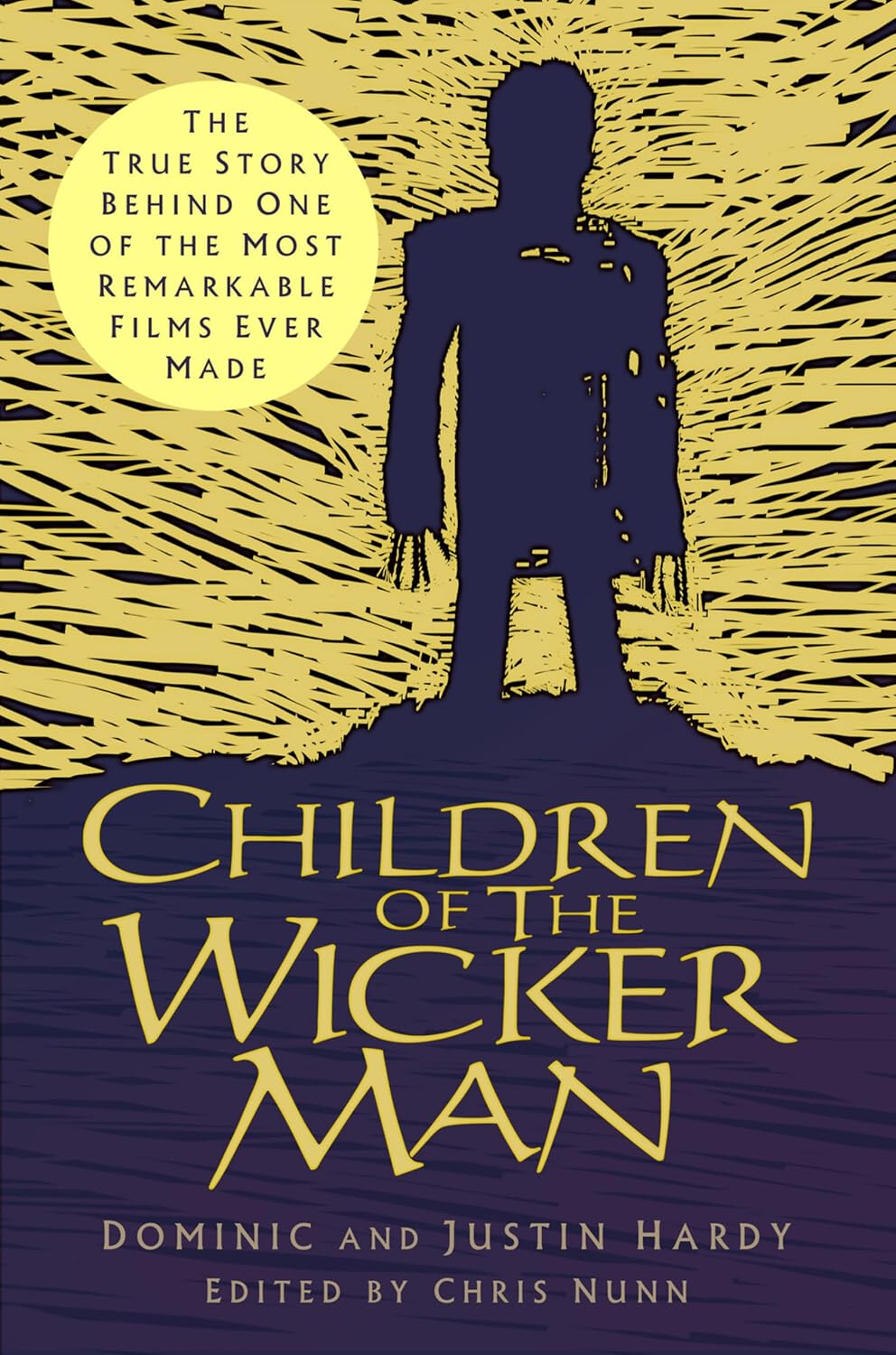

Severin Films recently released Justin and Dominic Hardy’s Children of the Wicker Man documentary on Blu-ray, and alongside that they also have copies of their companion book of the same name originally published by The History Press. The book version explores many of the same ideas brought forth in the film, but first and foremost the authors make it clear that in writing about their father Robin Hardy’s journey to create a film legacy, they are also intentionally telling the stories of the many various women in Hardy’s life who helped him in his successes. Over the course of his 86 years, Hardy was married multiple times; he ended up having eight children altogether, all of whom were abandoned in some way due to Hardy’s creative drive and his life’s work of telling the legacy of the Wicker Man, from his first feature film to the later sequels he would create. In book form, Children of the Wicker Man moves through the various eras of Robin Hardy’s work, from his early successes as an advertiser to his twilight years and falling-out with his Wicker Man partner Tony Shaffer.
Besides the obvious chronological structure, the book is also constructed around both Justin and Dominic’s viewpoints in Hardy’s life – the two share the task of disentangling the complicated and problematic relationships in Hardy’s life, each bringing a slightly different perspective to their framing. Of course, the book is fairly critical of Hardy as a whole, acknowledging his personal faults and the many fractures he caused in overall family life; this isn’t a book to mince words or to overwhelmingly laud one-half of the creative mind behind The Wicker Man, nor is it solely focused on that film’s lasting legacy or its production woes. It does explore The Wicker Man to great length, but less about the behind-the-scenes detail that has already been documented to death over the years than the true cost of its production on people like Elizabeth Richards, who bankrolled the film until financial ruin after Hardy left her in the subsequent years after The Wicker Man‘s initial flop.
While the book does hit on a lot of the same topics as the film, the real draw here is the book’s ability to get much more intimate with the thoughts and feelings of its two authors, who are not hesitant to offer their own opinions and critiques of Hardy’s life and works. Neither are particularly fond of Hardy’s late films, for example. But it’s important to note that Children of the Wicker Man is also not biased or unfair to Hardy, rightly pointing out so many of the great ideas the man fostered despite his own personal conflicts. The writing is compelling, the stories illuminating – and, intentionally, Children of the Wicker Man is overall dedicated to those in Hardy’s life that made sacrifices for his achievements. A helpful timeline at the end of the book allows the reader to traverse the tangled series of events throughout Hardy’s life that also serves as a nice companion to the documentary.