

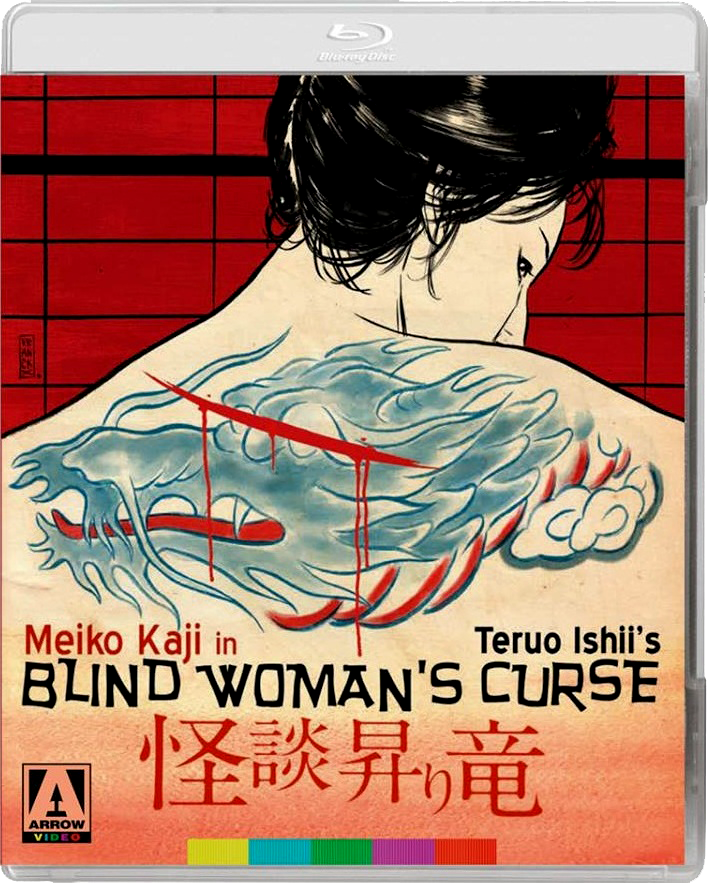
Presented is an archival review of Blind Woman’s Curse originally posted on TheMoonisaDeadWorld.net.
Teruo Ishii’s Blind Woman’s Curse is also known as Black Cat’s Revenge, a more apt title for this Japanese Yakuza ghost-cat flick from 1970 starring Meiko Kaji as head boss Akemi Tachibana. While Blind Woman’s Curse isn’t specifically a bakeneko, it does feature the animal as part of a supernatural curse that has fallen on the Tachibana clan and Akemi specifically; Ishii’s film uses this proclivity toward superstition as part of the revenge story that fuels the plot, eventually also adding in a hunchbacked character and some psychedelic, eerie carnival moments to add to the off-kilter approach to Japanese mobster cinema.
But Blind Woman’s Curse isn’t really a horror film – it’s first and foremost a story about seeking revenge through violence and attempting to remain honorable at the same time. Ishii begins with a quick fight sequence between the Tachibana clan and the Gouda clan, with Akemi slaying the leader of that group and, in the process, maiming his daughter. Jumping ahead three years, the film picks back up with Akemi after she gets out of jail and rejoins the Tachibana clan, but she recognizes that she’s being followed by a black cat that has seemingly cursed her and those around her.
The black cat is a symbol of revenge, and it shows up again and again during the first half of the film. But Ishii doesn’t introduce his blind antagonist, Aiko Gouda (Hoki Tokuda), until later in the movie. It leaves the viewer wondering what exactly Blind Woman’s Curse‘s plot is, because despite the vague hints at such a thing, the film moves quickly and lacks introductory explanation as to the Tachibana clan and their disputes with a rival gang led by Dobashi (Toru Abe). Part of this is intentional – Ishii wants to leave Aiko’s backstory untouched until the final confrontation – but it’s also due to poor blocking in the opening frame. I don’t think it’s much surprise, nor is it a spoiler – but I’ll warn you anyway – that the girl from the first sequence is Aiko, but all the same that opening shot leaves it difficult to tell how the girl has been injured. (end spoiler)
Yet Ishii doesn’t really need Aiko’s presence at first anyway. The tensions and conflict between Dobashi and Tachibana members is the immediate concern, especially because Dobashi has managed to get a spy, Tatsu (Shiro Otsuji), into the camp. Ishii introduces this dissent at first in a playful manner; Blind Woman’s Curse starts off nearly comedic with various overly dramatic moments and a comical appearance by Makoto Sato as Tani Shouichi. However, as the bodies begin to pile up and especially once Aiko infiltrates Dobashi’s ranks, things get deadly serious.
Ishii infuses Blind Woman’s Curse with a number of inventive sequences, some of them well-choreographed fight scenes and others weird but hypnotic shots of freak show antics. The film is not stiffly stuck in mobster dynamics, and it often switches off to include more horrific events including Ushimatsu the hunchback dancer (Tatsumi Hijikata) skinning members of the Tachibana clan and leaving them around for others to find. There’s also an inexplicable moment where one of the Tachibana members acts like a cat and smashes his face through a window, something you really don’t see much in ordinary cinema.
These moments are often odd and disjointed from the rest of the plot, which tends to follow Shouichi later in the film as he begins to fight against Dobashi when Tatsu murders his boss. It ushers in the main point of this revenge drama, though, that blood begets blood. Akemi refrains from violence, aware of its consequences, but is forced to retaliate after Dobashi’s altercations; the same is true of Shouichi, who, despite attempting to live a wholesome life, is pushed into violence yet again and forced to fight in defense of good people.
It’s summarized nicely by Aiko; with her heightened sense of smell, she can tell that Shouichi is a good person at heart. It doesn’t help them avoid a large-scale battle between Dobashi’s gang and the Tachibana clan, though – Ishii adds a denouement that is full of great choreography and lots of bloodshed, with the most fighting of the entire film packed into one chaotic scene. Better, though, is the climactic face-off between Aiko and Akemi, coming face-to-face after five years of Aiko’s seething anger. The battle is more tense than the payoff, but that doesn’t take away from Blind Woman’s Curse‘s conclusion – despite the rage and wrath, the forgiveness is often more satisfying.
It’s a powerful moment that works even though Blind Woman’s Curse doesn’t spend much time on this rivalry; in fact, the film is liberal in its use of character focus anyway. The consequence of violence, though, is a metaphor that runs throughout the film, from the rivalry between Dobashi and the Tachibana clan to the multiple characters leaving the gangster realm. It leaves an interesting dynamic between superstition and revenge that, while not exactly connected, come together to form a fascinating movie that stretches past generic Yakuza plotting into surrealistic territory.
Special Features
Arrow Video’s HD transfer of Nikkatsu Studio’s film looks great, especially the darker sequences and the colors (look for the opening sequence’s red on-screen kanji!). It comes with newly-translated English subtitles, although I found the way some of the scenes were translated to be odd – none of the background dialogue or exclamations have been translated, and though it’s not detrimental to the plot, it’s strange that they didn’t just do the whole thing.
The package doesn’t come with a ton of special features, but of note is the audio commentary track from Jasper Sharp, Japanese cinema expert. I didn’t get to listen to the entirety of the audio but I did watch quite a bit and, aside from his mesmerizing accent, Sharp explains a lot about Japanese cinema – from bakeneko to Nikkatsu’s output to similar films in the ’50s, ’60s, and ’70s. This is definitely worth a listen, especially if you’re like me: lacking knowledge in that area of cinema.
A trailer for Blind Woman’s Curse is included as well as four trailers for Meiko Kaji’s film series Stray Cat Rock.
Finally, a booklet insert with stills and an essay by Tom Mes rounds this package out! Updated: The booklet features full-color artwork and stills from the film, along with Mes’ essay about erotic-grotesque film. Blind Woman’s Curse fits loosely in that category, but Mes also goes into the “nonsense” of the film and similarities to Lewis Carroll’s Alice in Wonderland. It’s a very enlightening piece, and though I don’t necessarily agree with Mes’ claims that Blind Woman’s Curse is a “nonsense” film – despite the often disjointed moments of the movie, it does have meaning – the booklet inclusion is a great extra for collectors.